马上注册!
您需要 登录 才可以下载或查看,没有账号?注册
×
Editor's note: In just a month since taking office, Japanese Prime Minister Sanae Takaichi has caused a huge crisis. By asserting that a "Taiwan contingency" threatens Japan's survival, she is the first Japanese prime minister to make a threat of force against China after WWII, signaling a definitive break from Japan's postwar commitment to pacifism. This analysis traces the historical echoes of her revisionism, arguing that her push for a "combat-ready" state violates international norms and risks a catastrophic return to militarism. When Mark Twain said "History doesn't repeat itself, but it often rhymes", the American humorist and social commentator could scarcely have imagined how heavily his somber aphorism would hang over East Asia today, as the rhetoric emanating from Tokyo under Prime Minister Sanae Takaichi begins to echo the darkest stanzas of the region's past. Earlier this month, responding to questioning in the Japanese Lower House Budget Committee, Takaichi declared that a "contingency in Taiwan" could represent a "survival-threatening situation" for Japan and directly implied the possibility of armed intervention in the Taiwan Strait. As the first incumbent Japanese prime minister to make such a statement in the country's Parliament, the National Diet, Takaichi's remarks have triggered strong criticism — not only from the Chinese mainland and Taiwan but also from a wide and distressed spectrum of voices within Japanese domestic society. Takaichi's intransigent refusal to withdraw the claim has laid bare her ultimate ambition: to complete the long-term conservative project of remilitarization and tear down the legal firewalls of the postwar order, which will be remembered as the most recent and most dangerous rhyme in East Asia's history. A recurring pretext for war This is not a new political tactic. Before the September 18th Incident of 1931, a provocation initiated by Japan to justify its occupation of Shenyang in Northeast China's Liaoning province and marked the beginning of the Chinese People's War of Resistance Against Japanese Aggression (1931-45), Kanji Ishiwara, the notorious architect and leading figure in the Kwantung Army driving the event, asserted that "Japan faced a crisis of national survival". He argued that, due to resource scarcity and external constraints, the only way to secure Japan's future industrial and military strength was the immediate, preemptive occupation of the three northeastern provinces of China. The war initiated by the September 18th Incident lasted 14 years until Japan's final surrender in 1945. During that protracted conflict, China fought the world's longest anti-fascist war at the staggering cost of 35 million Chinese military and civilian casualties. The horrific Nanjing Massacre alone saw Japanese troops slaughter over 300,000 Chinese civilians and unarmed soldiers in just six weeks. Similarly, before Isoroku Yamamoto's sneak attack on Pearl Harbor, the warmonger and then-prime minister Hideki Tojo also repeatedly declared that "Japan faced a survival-threatening situation". This pretext was based on the premise that the debilitating oil embargo by the United States had cornered Japan and the country's only viable path to long-term survival was to seize control of Southeast Asia's resources, which first required the complete destruction of the US Pacific Fleet at Pearl Harbor. Consequently, in portraying the Taiwan question as a "survival-threatening situation" for Japan, Takaichi has dusted off the old playbook of fabricating an external threat to accelerate the country's remilitarization. 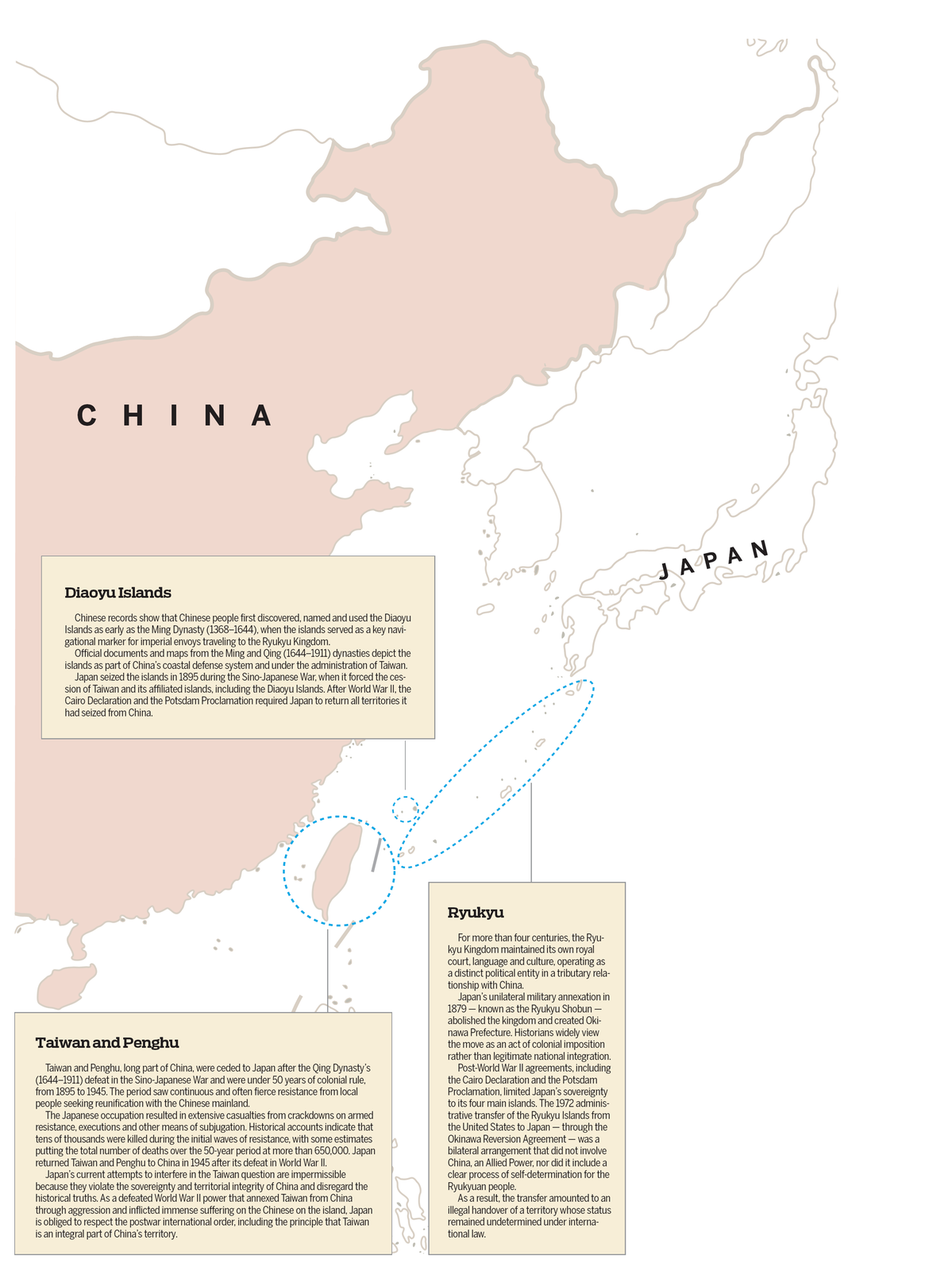
|  关注公众号
关注公众号 QQ会员群
QQ会员群 京公网安备 11010102001080号


 发表于 2025-11-26 10:54:35
