马上注册!
您需要 登录 才可以下载或查看,没有账号?注册
×
n a nursing home in Langfang, Hebei province, Wang Ming stares at the phone near his pillow. The screen lights up — a message from a patient-support WeChat group pops up, discussing the latest treatment for amyotrophic lateral sclerosis, or ALS. But he cannot reach out to tap it. His arms hang "like limp noodles", with only slight movement remaining in his right fingers. "If brain-computer interface (technology) could allow me to pick up the phone myself," he said, "even if it's just to open WeChat, I would be content." Wang is an ALS patient. Six years into the disease, he has only weak muscle control throughout his body. He is one of more than 500 patients who have signed up for clinical trials of BCI — and is among the majority still on the waiting list. 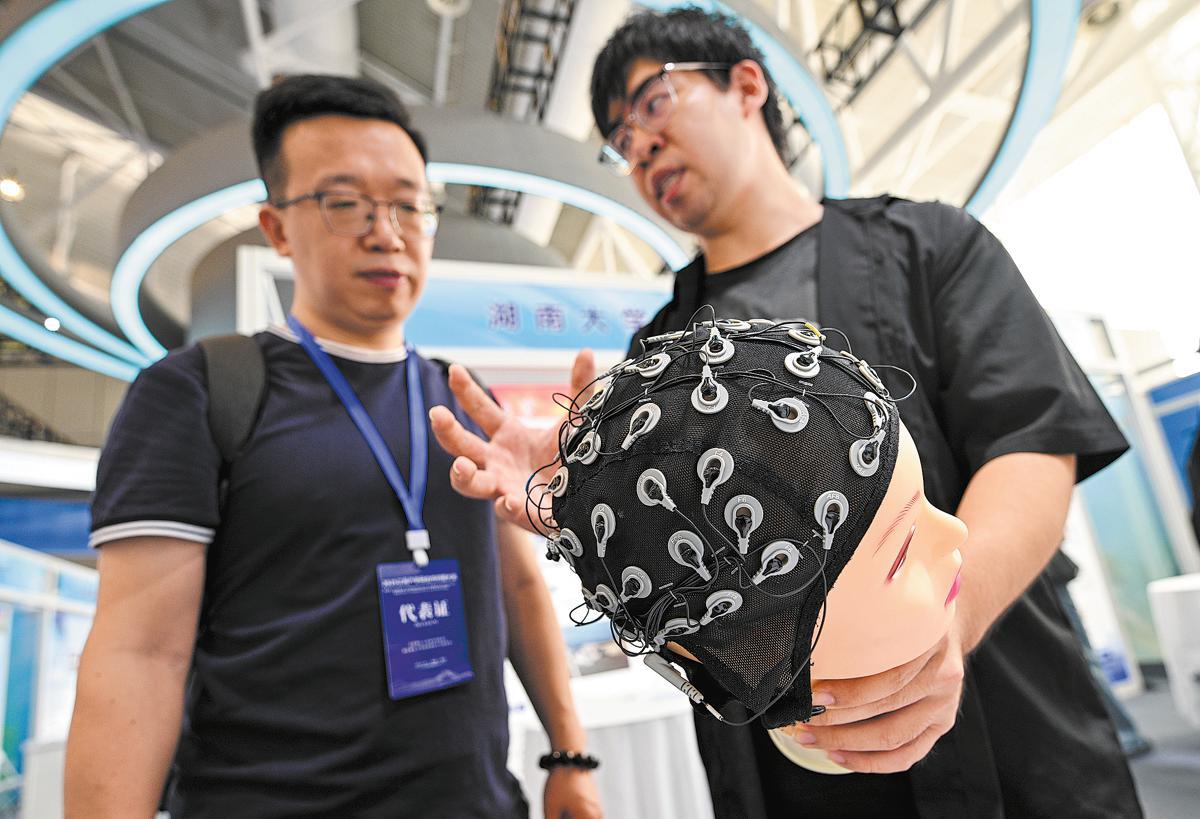 A visitor learns about a BCI system designed for amyotrophic lateral sclerosis patients at an industry - research cooperation conference at Nanjing International Exhibition Center, Jiangsu province, on Sept 12. [Photo provided to CHINA DAILY] A visitor learns about a BCI system designed for amyotrophic lateral sclerosis patients at an industry - research cooperation conference at Nanjing International Exhibition Center, Jiangsu province, on Sept 12. [Photo provided to CHINA DAILY]BCI technology functions as a digital bridge for the nervous system. When diseases like ALS or spinal cord injuries damage the neural pathways between the brain and muscles, BCI systems can bypass the blockage. "BCI is not science fiction — it is a bridge," said Professor Qu Yan, director of neurosurgery at the Second Affiliated Hospital of the Air Force Medical University of the People's Liberation Army, also known as the Tangdu Hospital, in Xi'an, Shaanxi province. "When spinal cord injury or motor neuron disease severs the neural pathway between the brain and limbs, BCI can bypass the damaged area, capture brain signals directly, decode them, and use them to control external devices or stimulate muscles," he said, explaining how BCI works. "For example, if a patient sees a flame and wants to move away, that 'wanting' signal is captured by the chip and converted into a command to move the hand," he added. While the foundational BCI research began decades ago in the West, Chinese teams are now rapidly advancing the technology. In July 2025, Nature reported that "China is rising swiftly in the field of brain-computer interfaces", with devices that even outperform Elon Musk's Neuralink project in certain aspects. "Although China does not have as long a research history in the field as the United States, development is extremely fast," Qu said, noting China's advantages in medical infrastructure and its population scale for testing.
|  关注公众号
关注公众号 QQ会员群
QQ会员群 京公网安备 11010102001080号


 发表于 2025-12-11 15:01:55
